

Understand the purpose, structure, and role of trusts in protecting and managing assets.
What Is a Trust and How Does It Work?

A trust is a legal arrangement that allows assets to be held, managed, and distributed according to specific instructions. Commonly used in estate planning, trusts can help provide privacy, avoid probate, protect family wealth, and create greater control over how assets are managed, preserved, and passed on with clarity.
At its core, a trust involves someone who creates it, someone who manages it, and someone who benefits from it. Understanding how trusts work can help individuals and families make informed decisions about protecting assets, supporting loved ones, preserving wealth, and planning responsibly for future generations.
The Purpose of a Trust

Protecting Wealth With Purpose and Long-Term Clarity
The Legal Framework to Protect Your Assets
A trust is a legal framework created to hold, manage, protect, and distribute assets according to clearly defined instructions. While often associated with estate planning, its broader purpose is to provide privacy, reduce probate complications, protect beneficiaries, preserve family assets, and create greater control over how wealth is managed and passed on according to your long-term intentions.
A Trust Holds and Manages Assets
One of the foundational purposes of a trust is its ability to legally hold, organize, and manage assets within a structured framework. Unlike simple personal ownership, where assets remain directly tied to an individual, a trust creates a separate legal arrangement through which assets are controlled according to established terms and objectives.
A trust can hold a broad range of property and financial resources, including real estate, bank accounts, investment portfolios, retirement considerations, business ownership interests, intellectual property, valuable personal possessions, and other forms of wealth. Once these assets are properly transferred into the trust, they are governed by the trust’s legal structure rather than informal personal management alone.
This distinction can be significant because it creates continuity, organization, and strategic oversight. For example, assets held in trust may continue to be managed according to clearly defined instructions even during incapacity, after death, or across multiple generations depending on the trust’s design.
In many cases, this structure can also reduce administrative complications, create centralized management, and support broader estate or asset protection strategies. Rather than viewing a trust as simply a document, it is often more accurate to understand it as a legal container designed to hold and manage wealth with greater precision, purpose, and long-term structure.
At its core, a trust transforms assets from individually held property into strategically managed resources governed by intentional planning.
A Trust Follows Specific Instructions
A defining strength of a trust is that it operates according to legally established instructions created by the person forming it. This allows the trust’s creator to determine not only who benefits from the assets, but also how, when, why, and under what circumstances those assets are managed or distributed.
These instructions are typically outlined within the trust agreement itself and can be broad or highly customized depending on the goals of the trust. For example, a trust may specify immediate transfers, staggered distributions over time, support for education, protection for minor children, charitable giving, business continuity provisions, or conditions intended to preserve family wealth responsibly.
This level of control is one of the primary reasons trusts are often used in sophisticated planning. Rather than relying solely on generalized inheritance or probate processes, a trust can create a tailored legal roadmap that reflects personal values, financial priorities, family concerns, and legacy goals.
The Trustee is legally obligated to follow these instructions according to fiduciary standards, helping ensure that the trust functions based on the creator’s wishes rather than outside assumptions.
In practical terms, this means a trust is not simply about transferring assets—it is about directing assets with precision. It allows wealth, property, or resources to remain connected to purpose long after the trust is created.
A Trust Can Protect People, Property, and Intentions
While many people initially associate trusts with wealth transfer, their broader purpose often includes protection—both financial and personal. Trusts can be structured to help safeguard assets, support beneficiaries, preserve privacy, and reinforce long-term intentions in ways that extend beyond basic ownership.
For families, trusts may help provide structured support for spouses, children, dependents, or future generations. For vulnerable beneficiaries, trusts can sometimes create protective layers that encourage responsible management or provide oversight where needed. For charitable or legacy-focused planning, trusts may also help ensure that specific missions, causes, or family priorities continue according to clearly defined wishes.
Beyond beneficiary protection, trusts may also serve practical planning purposes such as privacy preservation, probate avoidance strategies, continuity during incapacity, and more controlled asset administration. Depending on legal structure and jurisdiction, certain trusts may also support broader asset preservation goals.
Importantly, trusts are often about protecting intentions as much as assets. They allow individuals to establish not only what they own, but how those resources should ultimately serve people, values, and objectives over time.
In this way, a trust can become a powerful legal strategy for preserving both material wealth and personal purpose.
A Trust Can Function During Life or After Death
One of the reasons trusts remain such powerful planning tools is their flexibility across time. Depending on how a trust is structured, it may operate during the creator’s lifetime, become active upon incapacity, take effect after death, or continue long into the future for children, heirs, charitable purposes, or multigenerational planning.
Some trusts are designed to actively manage assets immediately, allowing the creator to maintain certain levels of involvement while establishing future protections. Others are designed primarily for estate transition, ensuring that assets are administered according to instructions after death without relying entirely on probate proceedings.
This adaptability allows trusts to serve a wide variety of purposes, from present-day asset management to long-term legacy preservation. A trust may provide continuity where life circumstances change, where beneficiaries need structured support, or where the creator wants long-term influence over how wealth or property is used.
In essence, a trust can function not merely as a one-time legal document, but as an ongoing framework capable of evolving across life stages and generations.
This long-range functionality is one of the key reasons trusts are often considered foundational tools in estate planning, family wealth preservation, and strategic legacy design.
Building Lasting Security
Why Trusts Matter

Privacy
Trusts can help keep certain personal, financial, and estate matters more private than public probate proceedings, offering families greater discretion and confidentiality.

Probate Avoidance
Many trusts are used to help assets transfer more efficiently while reducing delays, court involvement, and administrative burdens often associated with probate.

Asset Protection
Trusts may provide structured protection for wealth, property, and beneficiaries by creating legal frameworks designed to preserve assets responsibly.

Long-Term Family Support
Trusts can help provide ongoing financial support, control, and guidance for spouses, children, dependents, or future generations.
Key Roles Within a Trust
The Essential Roles That Shape a Trust
A trust typically involves three essential roles: the person who creates it, the person who manages it, and the person or people who benefit from it. Understanding this basic structure helps clarify how trusts function and how responsibilities are organized.
Grantor
The grantor is the person who creates the trust, transfers assets into it, and establishes the instructions that guide how those assets should be managed, protected, and distributed.
Trustee
The trustee is the person or institution responsible for managing the trust, carrying out its instructions, and overseeing assets in the best interests of the beneficiaries.
Beneficiary
The beneficiary is the person, family member, or organization designated to receive financial benefits, assets, or support from the trust according to its terms.
Understanding Your Options Can Help Shape a Stronger Plan
Choosing the Right Trust Structure
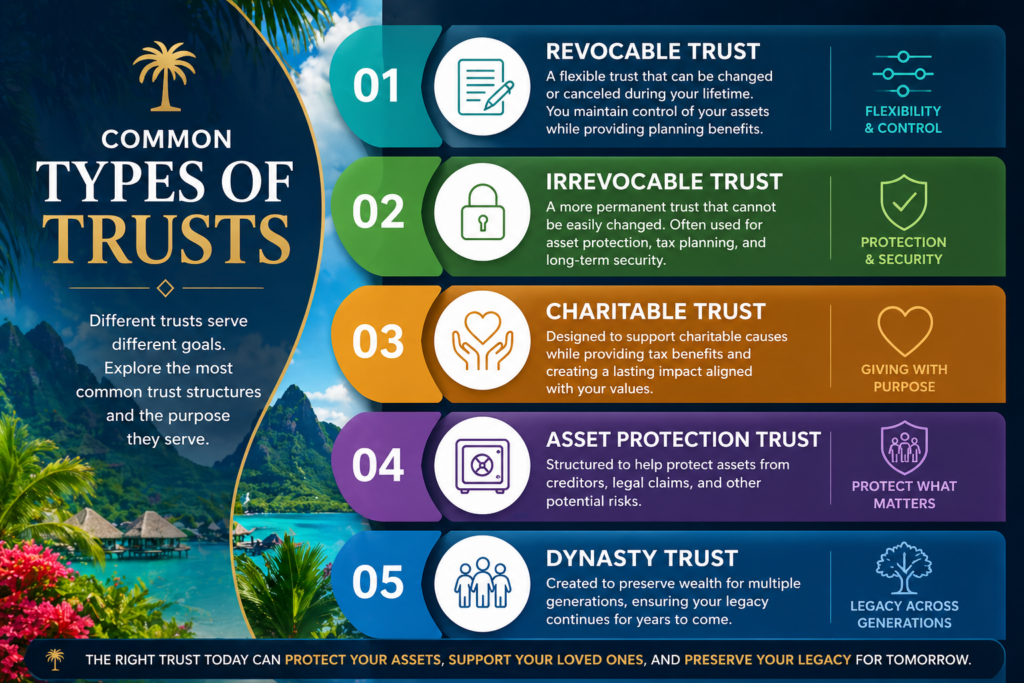
Different trusts are designed to serve different purposes, from maintaining flexibility and control to protecting assets, supporting charitable goals, or preserving wealth across generations. Understanding the most common types of trusts can help clarify how each structure supports specific financial, family, and long-term planning objectives.
Revocable Trust
A revocable trust, often referred to as a revocable living trust, is a flexible legal arrangement created to hold and manage assets during an individual’s lifetime while allowing the creator—commonly called the grantor—to maintain full control over those assets. Unlike more restrictive trust structures, a revocable trust can typically be amended, updated, or revoked entirely as circumstances, goals, or family needs change. This flexibility makes it one of the most commonly used trust structures in modern estate planning for individuals seeking organization, continuity, and greater control without permanently surrendering authority over their assets.
One of the primary advantages of a revocable trust is its ability to centralize asset management while creating a clear legal framework for how property, investments, real estate, or other assets should be handled both during life and after death. Assets placed into the trust remain available for the grantor’s use and benefit, and because the trust can generally be modified, it can adapt alongside life events such as marriage, divorce, business growth, births, deaths, or changing financial priorities. This adaptability often makes revocable trusts especially appealing for individuals and families who want estate planning tools without the permanence associated with irrevocable structures.
Revocable trusts are also widely used to help streamline the transfer of assets upon death by providing instructions for successor management and distribution. In many cases, they can help families avoid or reduce probate-related delays, maintain greater privacy than public court proceedings, and support more efficient administration of the estate according to the grantor’s wishes. Additionally, if the grantor becomes incapacitated, a properly structured revocable trust can allow a designated successor trustee to step in and manage trust assets without the need for more disruptive legal intervention, helping provide continuity and protection during uncertain times.
While revocable trusts offer substantial flexibility, organization, and planning benefits, they are often best understood as strategic management tools rather than absolute asset protection vehicles. Because the grantor typically retains control, assets in a revocable trust may not receive the same protective or tax-related treatment associated with certain irrevocable structures. However, for many individuals, the true value of a revocable trust lies in its combination of control, privacy, lifetime flexibility, and smoother transition planning.
At its core, a revocable trust is often used to create clarity, maintain authority, and establish a structured plan that can evolve with life while helping ensure that personal, financial, and family intentions are carried out more efficiently. For those seeking a balance between flexibility and thoughtful estate organization, revocable trusts remain one of the most practical and widely utilized foundational tools in trust planning.
Irrevocable Trust
An irrevocable trust is a legal arrangement designed to hold, manage, and protect assets under terms that are generally intended to be permanent once established. Unlike a revocable trust, which typically allows the creator to retain flexibility and control, an irrevocable trust often involves transferring assets into the trust in a way that limits or removes the grantor’s direct ownership or ability to unilaterally alter its core terms. This structural permanence is what often gives irrevocable trusts their strategic strength, particularly for individuals focused on long-term asset protection, wealth preservation, advanced estate planning, or legacy management.
Because assets placed into an irrevocable trust are commonly moved outside of the grantor’s direct control, this type of trust may offer important planning advantages depending on its structure, jurisdiction, and objectives. Irrevocable trusts are often used to help protect assets, preserve wealth for beneficiaries, support charitable planning, create more structured distribution strategies, or establish stronger separation between personal ownership and trust-held property. For families or individuals with more complex planning goals, this can make irrevocable trusts a powerful tool when flexibility is less important than protection, preservation, or strategic long-term outcomes.
One of the defining features of an irrevocable trust is its commitment to predetermined structure. Once assets are transferred and the trust is properly formed, changes may be limited, more difficult, or dependent on legal processes, trustee powers, or beneficiary consent. While this reduced flexibility can feel restrictive, it is often precisely what creates greater strategic certainty. By setting durable terms in advance, irrevocable trusts can help create disciplined frameworks for wealth management, family support, generational planning, or specialized financial strategies that are less vulnerable to future personal or situational changes.
Irrevocable trusts may also play an important role in more sophisticated estate and wealth planning strategies by helping create separation, structure, and continuity. Depending on design and legal context, they may be used in scenarios involving asset preservation, family wealth transfer, charitable objectives, life insurance planning, or multigenerational strategies. However, because these trusts can involve more permanent commitments and less direct control, they often require careful planning, thoughtful legal guidance, and clear long-term intent before implementation.
At its core, an irrevocable trust is often chosen not for convenience, but for strategic strength. It is a structure built around preservation, protection, and purpose—designed to create lasting frameworks that may help secure assets, support beneficiaries, and carry out carefully defined intentions over time. For those seeking stronger legal structure and long-term planning discipline, irrevocable trusts can serve as one of the most powerful tools in comprehensive trust and estate planning.
Charitable Trust
A charitable trust is a legal arrangement designed to support philanthropic goals while creating a structured framework for managing and distributing assets for charitable purposes. Unlike trusts focused primarily on personal or family wealth preservation, charitable trusts are often established to benefit qualified charitable organizations, causes, or public interests while also allowing the grantor to align financial planning with long-term values, legacy objectives, and strategic giving intentions. For individuals, families, or organizations seeking to make a meaningful impact, charitable trusts can serve as powerful tools that combine generosity with thoughtful planning.
At its core, a charitable trust allows assets such as cash, investments, real estate, or other property to be placed into a trust structure where they are managed according to specific charitable instructions. Depending on how the trust is designed, it may provide immediate support to charitable causes, create long-term recurring contributions, or balance charitable giving with financial benefits to the grantor or designated beneficiaries for a period of time. This flexibility makes charitable trusts especially appealing for those who want to support causes they care about while maintaining strategic oversight over how their charitable goals are carried out.
Charitable trusts are often used to create lasting philanthropic legacies, support nonprofits, fund education, advance community initiatives, or contribute to religious, medical, or humanitarian efforts. They can also help establish a more organized and intentional giving strategy than direct donations alone by creating structured timelines, management oversight, and clearly defined charitable purposes. For many, this transforms charitable giving from a one-time act into a long-term legacy strategy designed to reflect personal values and enduring impact.
In addition to their philanthropic purpose, charitable trusts may also play a role in broader financial and estate planning strategies depending on structure and jurisdiction. Certain charitable trust arrangements can be designed to support income planning, asset transition strategies, or broader legacy objectives while balancing charitable and personal goals. Because charitable trusts can vary significantly in complexity and legal design, they are often best approached with careful planning to ensure that both charitable intentions and strategic objectives are effectively aligned.
At its foundation, a charitable trust is more than a financial tool—it is a structured expression of purpose. It allows individuals and families to transform wealth into meaningful impact while creating a lasting framework for generosity, legacy, and strategic giving. For those who wish to preserve values alongside assets, charitable trusts can offer a unique bridge between personal planning and public good.
Asset Protection Trust
An asset protection trust is a legal structure designed to help preserve and safeguard assets through strategic trust planning intended to create stronger layers of separation, control, and long-term protection. While many trusts focus primarily on estate distribution or family wealth transfer, asset protection trusts are often structured with the goal of helping shield wealth, property, or financial resources within a legally established framework designed for preservation. For individuals, families, or business owners concerned with protecting what they have built, this type of trust can serve as an important component of broader wealth preservation planning.
At its core, an asset protection trust is typically designed to place certain assets into a trust structure where they are managed according to defined legal terms rather than remaining solely exposed under direct personal ownership. Depending on how the trust is formed, its jurisdiction, and the laws governing it, this structure may create additional barriers that support long-term preservation strategies. These trusts are often considered by those seeking to protect family wealth, preserve business interests, support legacy planning, or create more resilient structures around valuable assets over time.
One of the primary reasons asset protection trusts are utilized is their focus on proactive planning. Rather than simply transferring wealth, these trusts are often designed to help organize and preserve assets before potential financial, legal, or structural vulnerabilities arise. They may be used in broader planning strategies involving wealth preservation, multigenerational planning, business continuity, or structured family support. This forward-looking approach can make asset protection trusts particularly appealing for individuals with significant personal, professional, or financial responsibilities who want more strategic control over long-term preservation.
Because asset protection trusts can involve complex legal frameworks, jurisdictional considerations, and strategic limitations, they are often more sophisticated than basic trust structures. Their effectiveness may depend heavily on proper legal design, timing, compliance, and the specific objectives they are intended to support. As a result, they are generally most effective when approached as part of a carefully considered planning strategy rather than a one-size-fits-all solution.
At its foundation, an asset protection trust is often about preserving stability, protecting what has been built, and creating legal structure around long-term security. For those focused on wealth preservation, family protection, and strategic planning, asset protection trusts can represent a powerful tool designed to support resilience, continuity, and greater confidence in the future.
Dynasty Trust
A dynasty trust is a long-term trust structure designed to preserve, protect, and strategically transfer wealth across multiple generations. Unlike many trusts that focus primarily on immediate estate planning or direct asset distribution, dynasty trusts are often created with the broader purpose of establishing enduring family wealth structures that can continue to benefit children, grandchildren, and future descendants over extended periods of time. For families seeking to build lasting legacies, preserve generational assets, and create long-term financial continuity, a dynasty trust can serve as one of the most powerful strategic tools in advanced trust planning.
At its core, a dynasty trust is typically structured to hold and manage assets for successive generations according to carefully defined instructions established by the grantor. Rather than distributing wealth outright in a single transfer, this type of trust is often designed to preserve assets within a structured legal framework that may continue providing support, protection, or controlled distributions over decades or longer, depending on applicable laws and trust design. This allows families to create more intentional wealth strategies focused not only on inheritance, but also on preservation, governance, and legacy continuity.
One of the defining advantages of a dynasty trust is its emphasis on multigenerational planning. These trusts are often used to help preserve family wealth, support future beneficiaries, create structured financial guidance, and reduce the risk of wealth erosion through fragmented or poorly managed transfers. By maintaining assets within a long-term trust framework, dynasty trusts can help create continuity, strategic oversight, and a more disciplined approach to preserving family resources across generations.
Dynasty trusts may also be used to support broader legacy objectives such as family governance, education planning, philanthropic values, business continuity, or preserving important family assets over time. Because these trusts are generally designed with extended duration and complexity, they often require thoughtful planning, legal precision, and a clear understanding of long-term family goals. Their strength lies not simply in passing wealth forward, but in creating a durable structure intended to protect, guide, and preserve wealth over generations.
At its foundation, a dynasty trust is about more than inheritance—it is about legacy architecture. It represents a strategic approach to creating continuity, protecting what has been built, and shaping how wealth may support future generations with purpose and structure. For those focused on preserving family wealth beyond a single lifetime, dynasty trusts can offer a sophisticated framework for long-term protection, stewardship, and enduring legacy planning.
Learn More About Building Your Trust Strategy
For those who want to move beyond foundational trust education, additional guides and planning resources can provide deeper insight into trust structures, asset protection strategies, and long-term legacy planning. The following books and educational materials are designed to help expand your knowledge, strengthen your planning approach, and support the next step in building, protecting, or creating a trust strategy with greater clarity and confidence.
Revocable Trust
Flexible planning, lifetime control, and estate clarity
Irrevocable Trust
Long-term protection, structured preservation, and legacy security
Charitable Trust
Purpose-driven giving, strategic generosity, and lasting charitable impact
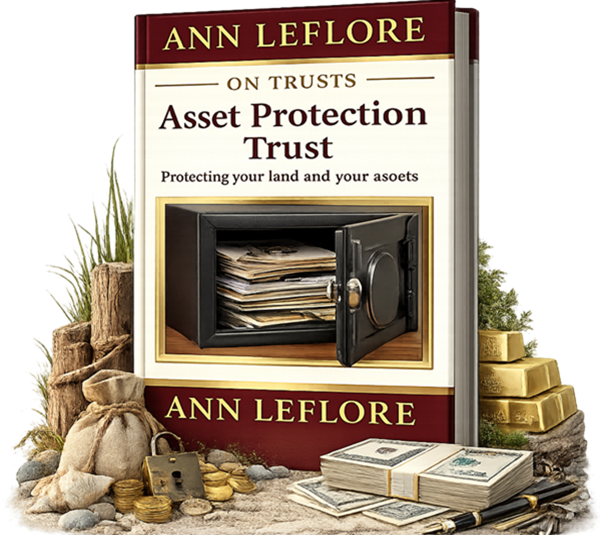
Asset Protection Trust
Strategic wealth protection, legal structure, and long-term asset preservation