
Glossary Volume I


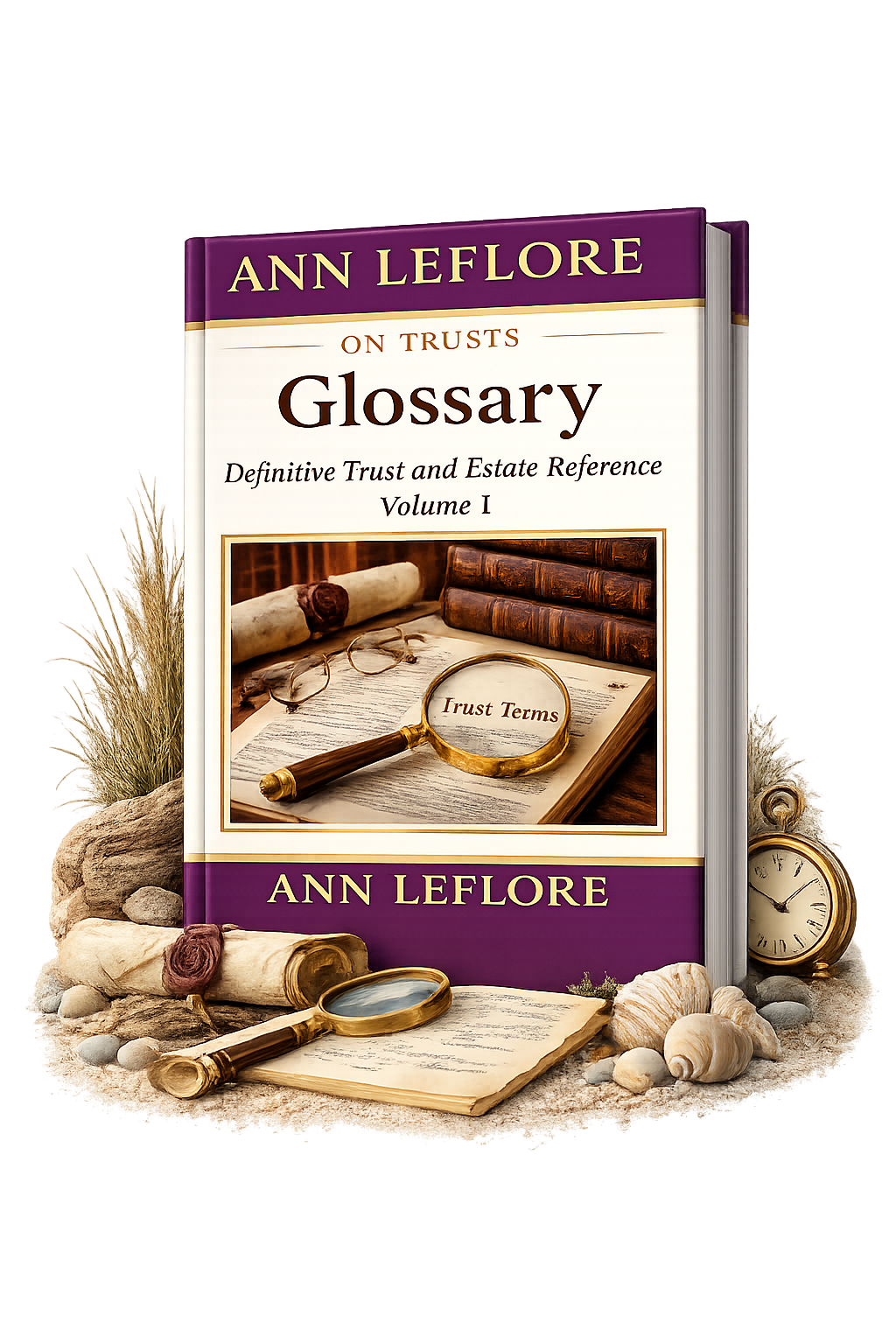
Glossary Volume I
Master the Language of Trusts, Estates, and Fiduciary Systems with Precision and Confidence
by Ann LeFlore
Strengthen your understanding of trusts, estate planning, and fiduciary structures with a definitive reference guide designed to help readers navigate the complex language that governs trust creation, administration, asset protection, accounting, beneficiary rights, and estate systems.
This encyclopedia introduces the essential terminology, legal concepts, fiduciary definitions, accounting systems, administrative structures, asset classifications, beneficiary frameworks, and trust types that form the foundation of trust and estate law—providing readers with a structured vocabulary for understanding how trusts actually function in legal, financial, and operational practice.
Whether your goal is learning trust language, improving fiduciary literacy, strengthening estate planning knowledge, understanding trust systems more clearly, or building a reliable legal reference library, Ann LeFlore provides a comprehensive foundation for mastering the terminology behind trusts, estates, and wealth preservation with greater clarity, structure, and confidence.
eBook: $49.95
What will you learn?
This guide gives readers a deeper look at the language, structure, and operational vocabulary that governs trusts, fiduciary systems, estate planning, asset protection, accounting, and trust administration. It explains the legal and practical meaning of trust terminology so readers can better understand how trust systems function, how legal concepts interconnect, and how precise language shapes effective trust creation, administration, and protection.
- What trust terminology actually means in legal, fiduciary, and practical contexts
- Why language precision matters in trust creation, administration, and estate planning
- How trusts function as legal systems through structured concepts and defined relationships
- The difference between legal meaning and practical application in trust terminology
- How trust vocabulary shapes fiduciary duties, beneficiary rights, and trustee obligations
- How accounting and reporting terminology supports trust administration and compliance
- Core trust accounting terms, including ledgers, journals, trial balances, basis, and financial reporting
- How fiduciary accounting differs from general accounting
- Administrative and operational trust terms used in real-world trust management
- Trustee appointment, resignation, succession, compliance, governance, and oversight terminology
- Asset and property classifications used in trust structures
- How trusts classify land, real estate, financial assets, business interests, digital assets, and personal property
- Beneficiary terminology, including vested interests, contingent interests, powers of appointment, and distribution rights
- How beneficiary rights and trust protections are defined through legal terminology
- Core trust types and how different trust structures are categorized
- The differences between revocable, irrevocable, charitable, offshore, domestic, land, dynasty, spendthrift, and specialty trusts
- How trust law, fiduciary duty, and estate systems intersect
- How trust operations, compliance systems, and governance structures are defined
- Key estate planning and wealth preservation terminology
- How tax, accounting, legal, and fiduciary language overlap in trust systems
- How to read trust documents, legal frameworks, and fiduciary systems more effectively
- How to identify common misunderstandings, misuse of terms, and structural misconceptions
- How trust concepts interconnect as part of a larger legal and operational framework
- How this glossary functions as both a legal reference and educational encyclopedia
- How to strengthen trust literacy for better planning, administration, asset protection, and legacy strategy.
Book Description
Glossary Volume I: Definitive Trust and Estate Reference by Ann LeFlore is a comprehensive trust and estate encyclopedia designed to provide readers with a structured, disciplined, and highly detailed reference system for understanding the language that governs trusts, fiduciary systems, estate planning, and wealth preservation.
More than a simple glossary, this volume functions as an expansive legal and operational reference guide that organizes trust-related terminology into a coherent framework spanning accounting, fiduciary administration, trustee operations, asset classification, beneficiary rights, trust structures, estate systems, and legal doctrine. It was created to address one of the most persistent challenges in trust education and administration: the fragmented, inconsistent, and often misunderstood terminology that underlies trust law and fiduciary practice.
Readers are guided through the legal meaning, practical application, fiduciary significance, and operational context of hundreds of trust and estate terms—covering everything from trust accounting and reporting systems to trustee governance, beneficiary classifications, asset categories, legal structures, and specialized trust types. By distinguishing formal legal definitions from practical real-world use, Glossary Volume I provides both clarity and functional understanding.
This book serves as a foundational educational tool for trustees, grantors, beneficiaries, estate planners, researchers, financial professionals, and individuals seeking to strengthen their mastery of trust systems through language precision. It also supports readers in interpreting trust documents, understanding fiduciary structures, improving estate literacy, and navigating complex trust frameworks with greater confidence.
Whether your goal is learning trust terminology, building a stronger legal vocabulary, improving trust administration knowledge, strengthening estate planning literacy, or developing a deeper understanding of how trust systems truly function, Glossary Volume I provides an authoritative roadmap for mastering the language of trusts and estates
Book Details
Title: Glossary Volume I: Definitive Trust and Estate Reference
Author: Ann LeFlore
Format: Digital Download / Educational Guide / Encyclopedia Reference
Category: Trust Education, Estate Planning, Fiduciary Law, Trust Administration, Legal Reference
Purpose: Educational and informational resource for understanding the legal, fiduciary, operational, and practical terminology that governs trusts, estate systems, fiduciary administration, accounting, asset protection, beneficiary rights, and wealth preservation
Focus Areas: Trust terminology, fiduciary definitions, accounting and reporting, trustee operations, trust administration, asset and property classifications, beneficiary rights, trust structures, estate systems, fiduciary governance, legal doctrine, trust literacy, and operational trust frameworks
Includes: Comprehensive alphabetical glossary and encyclopedia of trust and estate terminology, legal vs. practical term analysis, fiduciary accounting terminology, trustee administration terminology, asset classification systems, beneficiary terminology, trust type definitions, estate planning language, governance concepts, compliance terminology, operational frameworks, and educational reference systems
Ideal For: Trustees, grantors, beneficiaries, estate planners, legal researchers, financial professionals, accountants, trust administrators, business owners, students, and individuals seeking stronger trust literacy, fiduciary understanding, estate planning knowledge, and legal vocabulary precision
Delivery: Instant access upon purchase (if digital product)
Usage: Personal educational use
Table of Contents
- Copyright Notice
- Legal Disclaimer
- Dedication
- Foreword
- Preface
- How to Use This Book
- Abbreviations and Conventions
- Introduction
- How the Trust System Works
- How to Read This Encyclopedia (Glossary)
- Structure of Entries
- Legal vs Practical Meaning
- Section 1: Accounting and Reporting
- Account Current
- Accounting
- Accounting Income
- Adjusted Basis
- Annual Accounting
- Apportionment
- Audit
- Balance Sheet
- Beneficiary Statement
- Book Value
- Capital Account
- Cash Accounting
- Cost Basis
- Court Accounting
- Debit
- Disbursement
- Distribution Accounting
- Equitable Adjustment
- Fiduciary Accounting
- Fiduciary Income Tax Return
- Final Accounting
- Financial Statement
- Gain Allocation
- Income Allocation
- Income Statement
- Interim Accounting
- Inventory of Assets
- Journal Entry
- Ledger
- Net Accounting Income
- Principal Account
- Principal Allocation
- Receipt Allocation
- Reconciliation
- Reserve Account
- Schedule of Assets
- Tax Basis
- Trial Balance
- Uniform Principal and Income Act Report
- Section 2: Administration and Operations
- Acceptance of Trusteeship
- Administrative Powers
- Annual Review
- Appointment of Trustee
- Assumption of Trusteeship
- Beneficiary Communication
- Change of Trustee
- Co-Trusteeship
- Compliance Review
- Court Supervision
- Delegation of Authority
- Direction to Trustee
- Distribution Committee
- Duty to Inform
- Duty to Report
- Estate Administration
- Family Office Administration
- Fiduciary Administration
- Investment Administration
- Irrevocable Trust Administration
- Living Trust Administration
- Notice to Beneficiaries
- Operational Control
- Record Retention
- Removal of Trustee
- Resignation of Trustee
- Successor Trustee Appointment
- Testamentary Trust Administration
- Trust Administration
- Trust Advisory Committee
- Trust Company Administration
- Trust Department
- Trust Governance
- Trust Office
- Trust Operations
- Trust Oversight
- Trust Services
- Trustee Acceptance
- Trustee Resignation
- Section 3: Asset & Property Terms
- 401(k) Plan
- Accounts Receivable
- Adjusted Value Asset
- After-Acquired Property
- Agricultural Property
- Aircraft
- Alternative Assets
- Annuity Contract
- Antiques
- Appreciating Asset
- Artwork
- Bearer Instrument
- Boats and Watercraft
- Book Value Asset
- Brokerage Account
- Business Interest
- Carried Interest
- Cash
- Cash Equivalent
- Cash Value Life Insurance
- Certificate of Deposit
- Closely Held Business
- Collectibles
- Commercial Paper
- Commercial Property
- Commodities
- Common Stock
- Commingled Property
- Community Property
- Concentrated Position
- Condominium Interest
- Contract Rights
- Cooperative Housing Interest
- Corporate Bonds
- Cryptocurrency
- Custodial Account
- Custodied Asset
- Debentures
- Death Benefit
- Deferred Annuity
- Deferred Compensation
- Demand Deposit Account
- Depreciating Asset
- Derivative Instrument
- Digital Asset
- Digital Intellectual Property
- Digital Wallet
- Diversified Holding
- Distributed Property
- Domain Name
- Easement Interest
- Encumbered Property
- Equipment
- Exchange-Traded Fund (ETF)
- Exchanged Property
- Fair Market Value Asset
- Family Residence
- Farm Property
- Financial Asset
- Franchise Rights
- Fractional Interest
- Furnishings
- Futures Contract
- General Partnership Interest
- Gifted Property
- Government Securities
- Ground Lease Interest
- Growth Asset
- Hedge Fund Interest
- Held-in-Street-Name Asset
- Homestead Property
- Household Goods
- Identifiable Property
- Illiquid Asset
- Immediate Annuity
- Income-Producing Real Estate
- Inherited Property
- Individual Retirement Account (IRA)
- Jewelry
- Joint Tenancy Property
- Leasehold Interest
- Life Insurance Policy
- Limited Liability Company (LLC) Interest
- Limited Partnership Interest
- Mineral Interest
- Money Market Account
- Multi-Family Property
- Municipal Bonds
- Mutual Fund
- Nominee-Held Property
- Non-Income-Producing Asset
- Oil and Gas Interests
- Precious Metals
- Preferred Stock
- Promissory Note
- Remainder Interest in Real Property
- Right-of-Way
- Roth IRA
- Savings Account
- Separate Property
- Social Media Account Value
- Sole Ownership Property
- Stock Options
- Tokenized Asset
- Treasury Securities
- Trust Asset
- Trust Corpus
- Trust Estate
- Trust Fund
- Trust Principal Property
- Trust Property
- Undivided Interest
- Section 4: Beneficiary Terms
- Advancement
- Ascertainable Standard
- Beneficial Enjoyment
- Beneficial Interest
- Beneficial Ownership
- Beneficiary Consent
- Beneficiary Disclaimer
- Beneficiary Distribution Right
- Beneficiary Enforcement Right
- Beneficiary Information Right
- Beneficiary Standing
- Beneficiary Waiver
- Class Closing Rule
- Class Gift
- Conditional Gift
- Contingent Interest
- Crummey Power
- Current Interest
- Discretionary Distribution
- Distributable Net Income (DNI)
- Distributive Share
- Distribution Standard
- Dynasty Interest
- Equitable Conversion
- Equitable Interest
- Expectancy
- Family Maintenance Standard
- Future Interest
- General Power of Appointment
- Gift Over
- Heirs
- Heirs at Law
- Health, Education, Maintenance, and Support (HEMS)
- Income Interest
- Income Rights
- Limited Power of Appointment
- Mandatory Distribution
- Marital Deduction Interest
- Net Income Beneficial Interest
- Non-Vested Interest
- Per Capita Distribution
- Per Stirpes Distribution
- Permissible Appointee
- Power of Appointment
- Present Interest
- Principal Interest
- Qualified Disclaimer
- Qualified Terminable Interest Property (QTIP) Interest
- Remainder Interest
- Remote Interest
- Representation
- Residuary Interest
- Settlor’s Intent (as to Beneficial Enjoyment)
- Special Needs Interest
- Spendthrift Protection
- Sprinkling Power
- Substitutional Gift
- Support Interest
- Takers in Default
- Testamentary Power of Appointment
- Transfer for Value Rule (as affecting beneficiaries)
- Vested Interest
- Vested Remainder
- Withdrawal Right
- Section 5: Core Trust Types
- Accumulation Retirement Trust
- Accumulation Trust
- Art Trust
- Asset Protection Trust
- Backup Trust
- Bankruptcy Trust
- Blind Trust
- Business Trust
- Charitable Lead Annuity Trust (CLAT)
- Charitable Lead Trust (CLT)
- Charitable Lead Unitrust (CLUT)
- Charitable Remainder Annuity Trust (CRAT)
- Charitable Remainder Trust (CRT)
- Charitable Remainder Unitrust (CRUT)
- Common Law Trust
- Community Property Trust
- Complex Trust
- Conditional Trust
- Conservation Trust
- Constructive Trust
- Contingent Trust
- Conduit Trust
- Cooperative Trust
- Credit Shelter Trust (Bypass Trust)
- Cryptocurrency Trust
- Crummey Trust
- Delaware Statutory Trust (DST)
- Delegated Trust
- Descendant’s Trust
- Directed Trust
- Discretionary Trust
- Digital Asset Trust
- Domestic Asset Protection Trust (DAPT)
- Dynasty Trust
- Education Trust
- Employee Benefit Trust
- Endowment Trust
- Environmental Trust
- ERISA Trust
- Escrow Trust
- Express Trust
- Family Trust
- Foreign Grantor Trust
- Foreign Non-Grantor Trust
- Foundation Trust
- Funeral Trust
- Funded Trust
- Generation-Skipping Trust (GST Trust)
- Grantor Retained Annuity Trust (GRAT)
- Grantor Retained Income Trust (GRIT)
- Grantor Retained Unitrust (GRUT)
- Grantor Trust
- Guardianship Trust
- Gun Trust (NFA Trust)
- Honorary Trust
- Hybrid Trust
- Irrevocable Life Insurance Trust (ILIT)
- Implied Trust
- Income-Only Trust
- Income Trust
- Indenture Trust
- Intellectual Property Trust
- Intentionally Defective Grantor Trust (IDGT)
- Inter Vivos Trust (Living Trust)
- International Trust
- Investment Trust
- IRA Trust
- Irrevocable Trust
- Joint Trust
- Land Trust
- Litigation Trust
- Liquidation Trust
- Marital Trust
- Medicaid Trust
- Minor’s Trust
- Mineral Trust
- Mandatory Trust
- Nominee Trust
- Non-Grantor Trust
- Offshore Asset Protection Trust
- Offshore Trust
- Oil and Gas Trust
- Pension Trust
- Pet Trust
- Pooled Income Trust
- Pour-Over Trust
- Private Foundation Trust
- Profit-Sharing Trust
- Public Charitable Trust
- Purpose Trust (Non-Charitable Purpose Trust)
- Qualified Domestic Trust (QDOT)
- Qualified Personal Residence Trust (QPRT)
- Qualified Subchapter S Trust (QSST)
- Qualified Terminable Interest Property (QTIP) Trust
- Real Estate Investment Trust (REIT)
- Real Property Trust
- Receivership Trust
- Resulting Trust
- Retirement Trust
- Revocable Trust
- Security Trust
- Separate Share Trust
- Settlement Trust
- Silent Trust
- Simple Trust
- Special Needs Trust (Supplemental Needs Trust)
- Spendthrift Trust
- Sprinkling Trust
- Spousal Lifetime Access Trust (SLAT)
- Standalone Retirement Trust
- Standby Trust
- Statutory Trust
- Structured Settlement Trust
- Successor Trust
- Support Trust
- Testamentary Trust
- Timber Trust
- Tokenized Asset Trust
- Totten Trust (Payable-on-Death Trust)
- Trust (General Concept)
- Unfunded Trust
- Unit Trust (Unitrust)
- Voting Trust
- Wealth Replacement Trust
- Wraparound Trust
- Index
About the Author

eBook: $49.95
Ann LeFlore is an author and educational resource creator focused on trust organization, estate structure, and private trust frameworks. Through her work, she provides practical tools, instructional materials, and trust-based educational resources designed to help individuals and families better understand the process of creating, funding, organizing, and managing trust structures with greater clarity.
Her work emphasizes accessible trust education, structured planning, and practical guidance, offering readers step-by-step resources, templates, and organizational frameworks intended to simplify complex trust concepts. Through her books and educational materials, Ann LeFlore’s mission is to help readers move forward with greater confidence, organization, and understanding in their trust planning journey.