
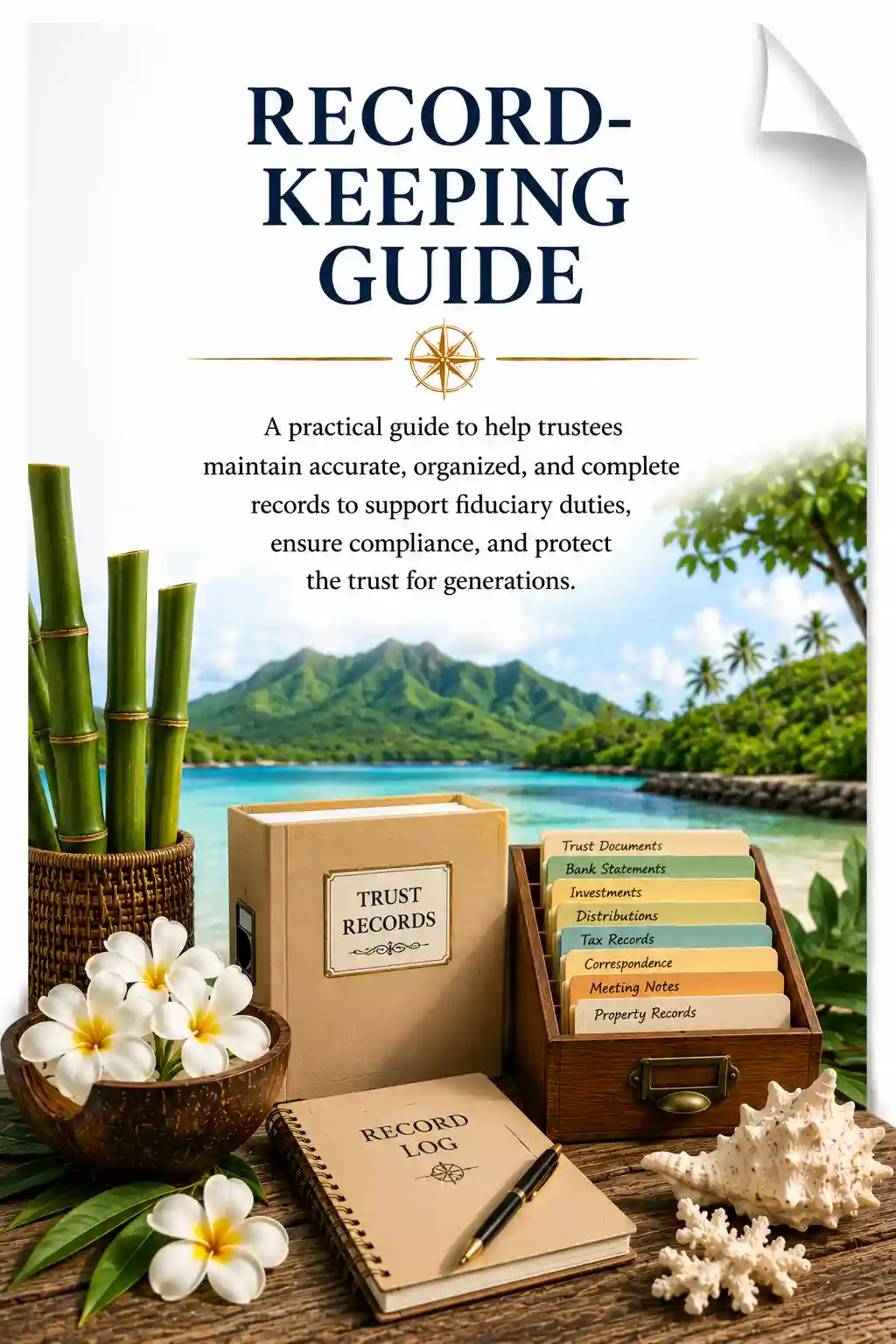
Record-Keeping Guide




Record-Keeping Guide
What to Keep, Why It Matters, and How to Protect Your Trust From Being Disputed or Challenged by Ann LeFlore
A trust is only as strong as the paper trail behind it. Even a properly drafted and funded trust can be challenged in court if there’s no clear record of how it was created, managed, and administered over time.
This guide walks through eight categories of records every trust should maintain — formation documents, funding and asset transfer records, trustee administration records, financial and tax records, communication and consent records, insurance and risk records, and health/capacity records — plus retention and storage guidance, with a status tracker for each item: Currently Maintained, Need to Start, or Needs Review/Locate.
Whether you’re a grantor setting up a record system from scratch or a trustee auditing what’s already on file, this guide gives you a complete, practical way to close the gaps that disgruntled heirs, creditors, or former spouses look for when challenging a trust.
PDF: $4.98
What's Inside
- Why record keeping protects your trust — and why courts look at it in a dispute
- Section 1 — Trust Formation & Governing Documents
- Section 2 — Funding & Asset Transfer Records
- Section 3 — Trustee Administration Records
- Section 4 — Financial & Tax Records
- Section 5 — Communication & Consent Records
- Section 6 — Insurance, Liability & Risk Records
- Section 7 — Health, Capacity & Incapacity Records
- Section 8 — Retention, Storage & Successor Access guidance
- Record Keeping Tracker & Notes pages
Product Description
The Record Keeping Guide by Ann LeFlore is a practical, attorney-informed framework for the documentation every trust should have on file. Courts evaluating a trust contest look closely at the consistency and completeness of records — execution documents, funding records, accountings, and communications — to determine whether a trust was properly created and administered. This guide identifies every major record category, explains why it matters, and gives you a simple way to track what’s currently maintained, what still needs to be gathered, and what requires attorney or institution follow-up.
It also includes retention and storage guidance — what to keep permanently, how long to keep statements and accountings, and how to make sure a successor trustee can actually find everything when they need it.
Title: Record Keeping Guide
Author: Ann LeFlore
Format: Digital Download / Educational Guide
Category: Trust Administration, Trust Law, Estate Planning Pages: 13
Ideal For: Grantors and trustees building or auditing a trust’s record-keeping system
Delivery: Instant access upon purchase
Usage: Personal educational use
Disclaimer
This guide is intended for general educational and informational purposes only and does not constitute legal advice. It is the exclusive intellectual property of Ann LeFlore On Trusts; unauthorized reproduction, distribution, resale, or presentation of this material as your own is strictly prohibited, and this document is licensed for personal use only. State law governs how trusts must be administered, what notices must be given to beneficiaries, and how long specific records must be retained — review your record-keeping practices with a qualified attorney at least annually.