
Trustee’s Duties

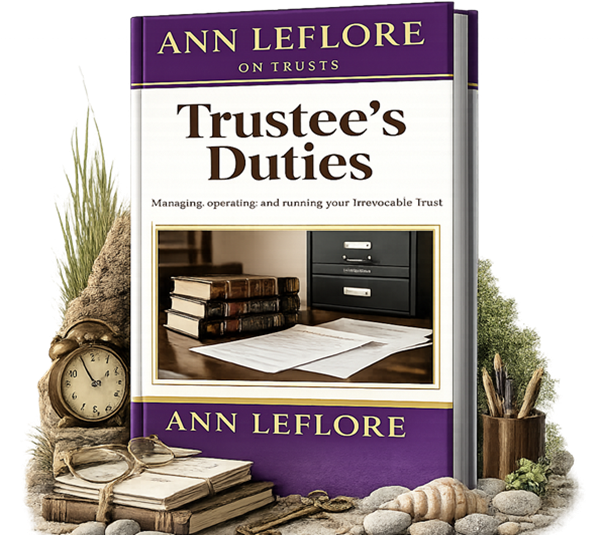






Trustee’s Duties
Understanding Your Legal Responsibility, Fiduciary Role, and the Real Work of Running an Irrevocable Trust
by Ann LeFlore
Step into the true role of trustee with a practical legal guide designed to help you understand, manage, and properly execute the serious responsibilities that come with controlling and administering an irrevocable trust.
This book introduces the real-world legal framework behind trustee authority, fiduciary obligations, trust operation, asset control, compliance, decision-making, and structural discipline—showing trustees what is actually required to preserve trust legitimacy, maintain separation, and avoid the operational mistakes that can expose a trust to failure.
Whether your goal is protecting trust assets, understanding fiduciary law, avoiding trustee liability, preserving legal compliance, or learning how to properly manage an irrevocable trust under real-world scrutiny, Ann LeFlore provides a structured foundation for operating as a trustee with clarity, accountability, and confidence.
eBook: $49.95
What will you learn?
This guide gives readers a deeper look at what it truly means to serve as trustee of an irrevocable trust and how fiduciary authority must be exercised under real legal scrutiny. It explains trustee duties, fiduciary standards, trust operation, separation requirements, compliance obligations, governance systems, legal limitations, enforcement risks, and the operational failures that can expose trustees and trusts to challenge.
- What an irrevocable trust actually means in law—not marketing
- The difference between irrevocability, trust validity, and legal durability
- How trustee authority functions within an irrevocable trust structure
- The trustee’s role as legal owner with fiduciary constraints
- Why trustees must understand separation of ownership, control, and beneficial enjoyment
- How courts, creditors, and taxing authorities evaluate irrevocable trusts in practice
- Why trustee conduct—not just trust documents—determines legal credibility
- The legal duties of loyalty, prudence, impartiality, accounting, and compliance
- How trustee independence affects trust legitimacy and survivability
- How retained settlor control, informal administration, or poor governance can collapse trust protections
- The difference between legal title and practical control
- How fiduciary administration protects against sham trust, alter ego, and recharacterization claims
- How trust funding, asset control, and operational discipline affect trustee responsibility
- How trustees manage property, distributions, documentation, and beneficiary relationships
- How appointment powers, protectors, and governance structures influence fiduciary risk
- How fraudulent transfer law, creditor reach, and timing affect trust vulnerability
- How IRS analysis differs from judicial and creditor analysis
- How trustees can become personally exposed for breach of fiduciary duty
- Common structural and operational failures that weaken irrevocable trusts
- How courts modify, terminate, or penetrate irrevocable trusts despite “irrevocable” language
- How trustees evaluate trust proposals, legal limits, and enforcement exposure
- How to identify red flags in trust design, administration, and governance
- How trust law distinguishes appearance from actual legal function
- How to preserve fiduciary discipline, compliance, and trust defensibility over time
- How practical checklists, doctrinal frameworks, and analytical systems help trustees operate more effectively.
Book Description
Trustee’s Duties by Ann LeFlore is a comprehensive legal and operational guide for trustees, grantors, fiduciaries, and families who want to understand what it truly means to manage, administer, and defend an irrevocable trust under real-world legal scrutiny.
Designed as both an educational resource and fiduciary governance framework, this book moves beyond surface-level trust concepts and focuses on the legal realities trustees face when exercising authority over trust property. Readers are guided through the structure of irrevocable trusts, fiduciary law, trustee authority, separation requirements, operational discipline, beneficiary obligations, governance systems, compliance duties, and the practical consequences of poor trust administration.
Rather than treating irrevocable trusts as abstract planning tools, Trustee’s Duties explains how courts, creditors, regulators, and taxing authorities evaluate trustee conduct, control, retained powers, beneficial enjoyment, and fiduciary independence when determining whether a trust will be respected, challenged, modified, or penetrated. The book also addresses trustee liability, breach of fiduciary duty, structural weaknesses, governance failures, fraudulent transfer concerns, and the practical limits of irrevocable trust design.
Whether your goal is properly serving as trustee, preserving trust legitimacy, protecting trust assets, understanding fiduciary obligations, avoiding costly operational mistakes, or learning how irrevocable trusts function in law rather than theory, Trustee’s Duties provides a structured roadmap for managing and operating trusts with legal clarity, professional discipline, and long-term defensibility.
Book Details
Title: Trustee’s Duties
Author: Ann LeFlore
Format: Digital Download / Educational Guide
Category: Trustee Responsibilities, Irrevocable Trust Administration, Fiduciary Law, Trust Compliance, Legal Operations
Purpose: Educational and informational resource for understanding, managing, administering, and legally operating as trustee of an irrevocable trust through proper fiduciary discipline, trustee authority, compliance systems, governance structures, and operational safeguards
Focus Areas: Trustee duties, fiduciary law, irrevocable trust structure, trustee authority, separation requirements, trust governance, asset control, beneficiary obligations, compliance systems, fiduciary liability, breach prevention, trust administration, creditor exposure, IRS scrutiny, legal defensibility, and operational trust preservation
Includes: Comprehensive trustee governance frameworks, fiduciary duty analysis, irrevocable trust legal structures, operational compliance systems, governance and separation frameworks, trustee authority tools, enforcement risk analysis, structural failure patterns, doctrinal checklists, practical trustee systems, legal reference materials, and trust administration resources
Ideal For: Trustees, successor trustees, grantors, fiduciaries, estate planners, trust administrators, legal researchers, property owners, business owners, and individuals seeking stronger trustee competence, fiduciary compliance, legal clarity, and long-term trust protection
Delivery: Instant access upon purchase (if digital product)
Usage: Personal educational use
Table of Contents
- Copyright Notice
- Notice to the Reader
- Foreword
- Dedication
- Glossary of Terms
- Introduction
- Chapter 1: What “Irrevocable” Means in Law (Not Marketing)
- Part I: The Term “Irrevocable Trust” as a Misused Legal Classification
- Irrevocability as Classification, Not Permanence
- How the Term Is Commonly Used Outside Legal Analysis
- The Legal Meaning of Irrevocability
- Divergent Institutional Frameworks: IRS Analysis Versus Judicial Analysis
- Mapping Misconceptions to the Operative Legal Questions
- Questions Commonly Asked—and Why They Are Legally Misframed
- Practitioner Method: How Lawyers Evaluate “Irrevocable” Trust Risk
- Judicial Treatment in Contested Proceedings
- Chapter 2: Why Irrevocability Does Not Place Assets Beyond Reach
- Separation as a Legal Requirement, Not a Label
- Creditor Reach and Debtor–Trust Relationships
- IRS Reach and Tax Inclusion
- Structural and Operational Failures
- The Predictable Pattern of Trust Failure
- Chapter 3: How Irrevocable Trusts Collapse When Tested
- Triggers That Bring Irrevocable Trusts Under Scrutiny
- Procedural Posture of Trust Challenges
- Doctrinal Paths to Collapse
- Judicial Remedies and Outcomes
- Why Collapse Is Predictable, Not Exceptional
- Chapter 4: What Irrevocable Trusts Can Actually Accomplish
- The Legitimate Functions of Irrevocable Trusts
- When Irrevocable Trusts Work as Intended
- Structural Designs That Survive Scrutiny
- The Cost of Making an Irrevocable Trust “Work”
- Common Attempts to Avoid the Cost (and Why They Fail)
- Designing Within Legal Reality
- Chapter 5: Separation: How It Is Supposed to Work (and Where It Fails)
- The Concept of Separation in Trust Law
- Legal Title, Control, and Beneficial Enjoyment
- Governance Structures and Trustee Independence
- Operational Separation and Administration
- Doctrines That Test Separation
- Common Structural Failures of Separation
- Why Separation Is Rarely Achieved
- Chapter 6: Enforcement: How Irrevocable Trusts Are Actually Penetrated
- Creditor Enforcement Pathways
- Tax Enforcement and Attribution
- Judicial Remedies in Trust Litigation
- Fiduciary Exposure During Enforcement
- The Irreversibility of Enforcement Collapse
- Chapter 7: The Legal Limits of Irrevocable Trust Design
- Non-Negotiable Doctrinal Constraints
- What Drafting Cannot Accomplish
- Structural Tradeoffs in Irrevocable Planning
- Evaluating Irrevocable Trust Proposals
- When Irrevocable Trusts Are Appropriate
- When Irrevocable Trusts Should Not Be Used
- Chapter 8: Irrevocable Trusts Without Illusion: A Legal Framework for Evaluation
- Ownership Attribute Analysis
- Governance and Administration Overlay
- Predicting Enforcement Outcomes
- Evaluating Real-World Trust Proposals
- Accepting the Cost of Legal Effectiveness
- Chapter 9: The Reality of Irrevocable Trusts: Final Conclusions and Legal Consequences
- What the Law Ultimately Requires
- What Irrevocable Trusts Can Reliably Do
- What Irrevocable Trusts Cannot Do
- Why Failure Is Systemic, Not Accidental
- The Discipline of Realistic Use
- Chapter 10: Applying the Framework: Reading, Testing, and Evaluating Irrevocable Trusts
- How to Read an Irrevocable Trust Instrument
- Structural Mapping of Trust Arrangements
- Operational Fact Pattern Reconstruction
- Enforcement Simulation Methodology
- Red Flag Identification
- Chapter 11: What Irrevocable Trusts Are Mistaken For (and Why the Confusion Persists)
- Irrevocable Trusts Versus Revocable Trusts
- Irrevocable Trusts Versus Asset Protection Structures
- Irrevocable Trusts Versus Spendthrift Protection
- Irrevocable Trusts Versus Tax Exclusion Mechanisms
- Why These Confusions Persist
- Chapter 12: Doctrinal Frameworks, Definitions, and Analytical Reference
- Core Doctrinal Concepts
- Governing Doctrines by Analytical Category
- Structural and Governance Concepts
- Operational Indicators and Evidence
- Enforcement Pathways Reference
- Failure Typologies
- Analytical Checklists
- Cross-Chapter Doctrinal Map
- Appendix A: Case Patterns in Irrevocable Trust Failure and Enforcement
- Appendix B: Offshore Trust Mythology and Ownership Attribution
- Appendix C: Bankruptcy as a Distinct Doctrinal Lens
- Appendix D: Evidentiary Allocation in Trust Enforcement
- Appendix E: Mixed-Fact Trusts and Partial Enforcement Outcomes
- Appendix F: Practitioner Usage Patterns Producing Structural Failure
- Appendix G: Lifecycle of an Irrevocable Trust Under Legal Scrutiny
- Appendix H: Predictable Human Conduct in Trust Administration
- Appendix I: Structural Pressures on Fiduciary Independence
- Appendix J: Doctrinal Failure Versus Procedural Exposure
- Appendix K: What Trust Law Will Not Accommodate
- Index
About the Author

eBook: $49.95
Ann LeFlore is an author and educational resource creator focused on trust organization, estate structure, and private trust frameworks. Through her work, she provides practical tools, instructional materials, and trust-based educational resources designed to help individuals and families better understand the process of creating, funding, organizing, and managing trust structures with greater clarity.
Her work emphasizes accessible trust education, structured planning, and practical guidance, offering readers step-by-step resources, templates, and organizational frameworks intended to simplify complex trust concepts. Through her books and educational materials, Ann LeFlore’s mission is to help readers move forward with greater confidence, organization, and understanding in their trust planning journey.